Unlock Culture: 5 incredible exhibitions to explore in Manhattan
September 2, 2025
New York City is home to some of the foremost cultural institutions across all boroughs. The island of Manhattan, in particular, offers a dizzying array of attractions. From group shows that engage with place and memory in America to single-artist surveys, magazine manuscripts to Mesoamerican masks, to the return of the Art in Ancient Americas collection, you’ll always be spoiled for choice in Manhattan — especially with Bloomberg Connects as your guide.
A Century of The New Yorker
At The New York Public Library until February 21, 2026
The New York Public Library’s exhibition A Century of The New Yorker celebrates the people, stories, and ideas that have fueled the iconic magazine. Known for its groundbreaking cover art, literary prose, and journalistic rigor, The New Yorker debuted in 1925 as “a reflection in word and picture of metropolitan life” and has since published 5,057 issues.
The New Yorker successfully weathered the transition to a digital age, retaining its circulation and cultural relevance—even launching a literary festival. Over the past two decades, the magazine has published landmark pieces on the opioid crisis and the transformative #MeToo and Black Lives Matter movements.
Drawn from the New York Public Library’s voluminous archive of New Yorker materials, the exhibition includes manuscripts, memos, correspondence, and cartoons. Visitors are invited to discover “the unsung stories of prickly editorial relationships, diligent typists, fastidious fact checkers, and talented artists,” who have made the magazine what it is today. The audio guide features a variety of voices, including curators Julie Golia and Julie Carlsen, creative director Nicholas Blechman, and poetry editor Kevin Young.
Rashid Johnson: A Poem for Deep Thinkers
At Guggenheim until January 18, 2026
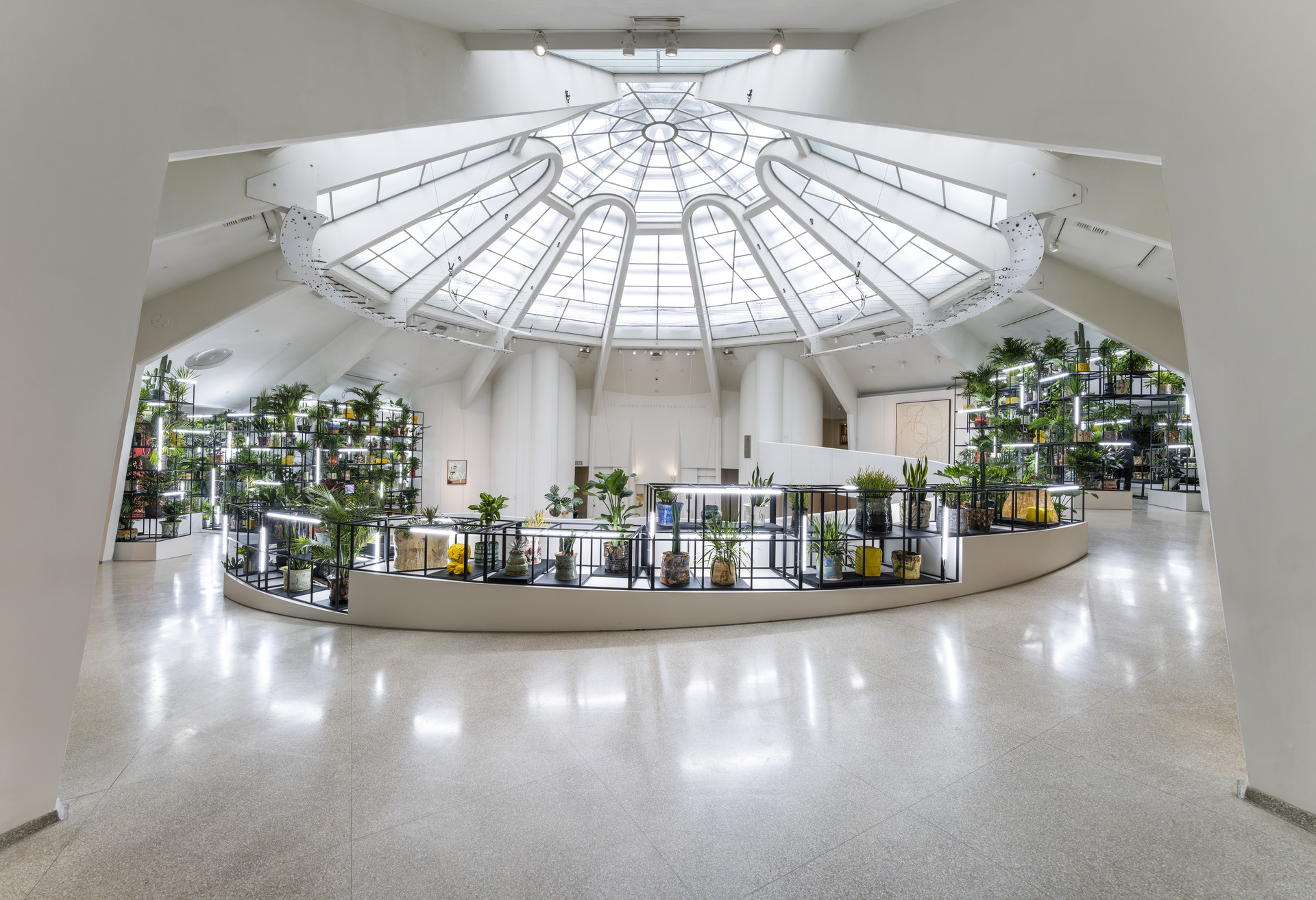
One of Manhattan’s most recognizable landmarks, the Guggenheim is host to Chicago-born, NYC-based artist Rashid Johnson’s A Poem for Deep Thinkers. This solo exhibition brings together nearly 90 works from the past 30 years of his career. Johnson is relatively young for a major survey show, which demonstrates “how youthful energy morphs into a mature practice,” says curator Naomi Beckwith.
Arranged chronologically along the Guggenheim’s spiral, the works navigate between the personal and the political. Johnson has said that “the subject of my work is freedom,” and he plays with language, material, and form to question the beliefs of the 21st century. His material experimentation includes mirrored glass, bath tiles, black soap, and shea butter, which become cultural signifiers in his work.One of the highlights is Sanguine, a monumental site-specific work with an embedded piano for musical performances. Johnson often uses music or text as prompts, and the exhibition’s title is borrowed from a poem by Amiri Baraka. The audio guide includes readings of select poems from the catalogue, including works by Toni Morrison and Paul Beatty.
“Untitled” (America)
At the Whitney Museum of American Art
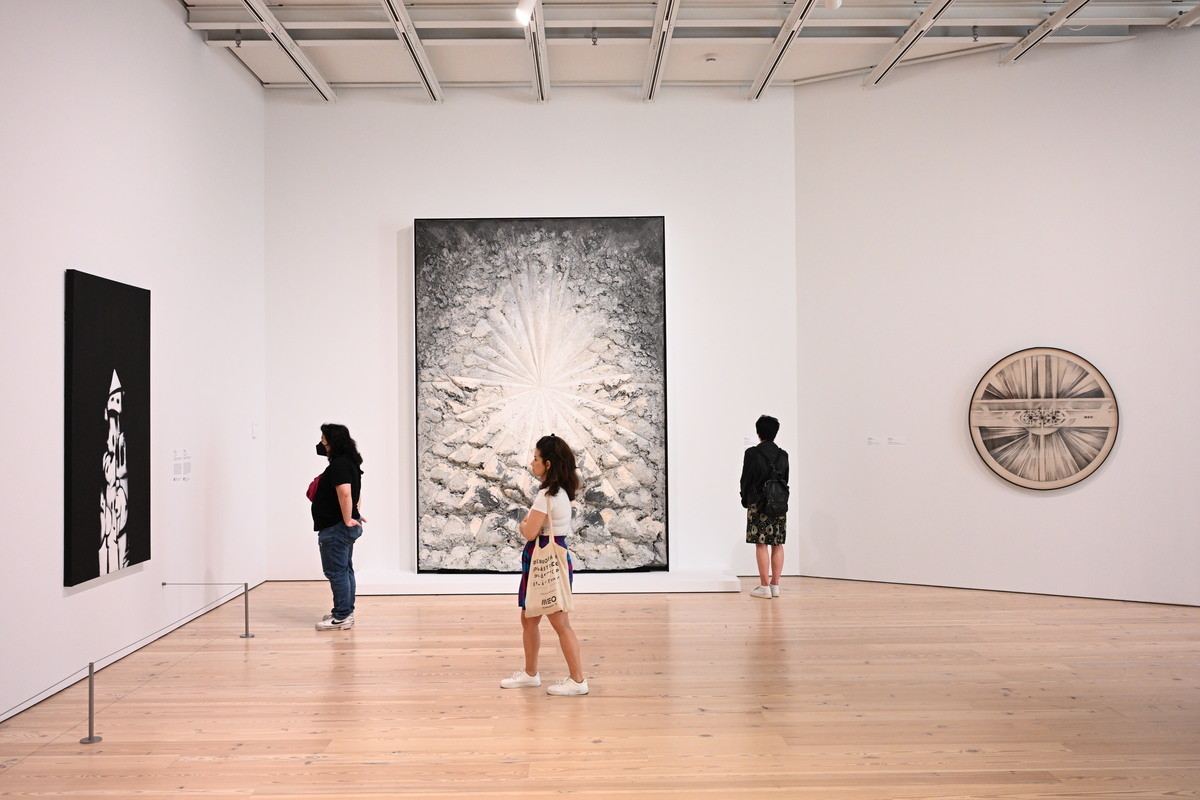
The Whitney’s exhibition “Untitled” (America) pays homage to artist Felix Gonzalez-Torres, who acknowledged the contradictions of America as “a place of opportunities, of risks, of justice, of racism, of injustice, of hunger and excess, of pleasure and growth.”
Drawn from the Whitney’s collection of American art, amassed over the past century, the exhibition features heavy-hitters such as Edward Hopper, Georgia O’Keeffe, Jean-Michel Basquiat, and Alice Neel, whose work has come to define the nation’s cultural consciousness. It also treads the fault-lines identified by Gonzalez-Torres. The patriotic symbolism in paintings like Jasper Johns’ Three Flags (1958) is undercut in others, such as American Totem (1960), in which Norman Lewis references a history of racial violence and inequality.
While Rosalyn Drexler invokes Marilyn Monroe and the dark side of celebrity, Kay WalkingStick turns inward to explore her own multiplicity as a woman, artist, and mother of Cherokee ancestry. Ultimately, visitors are invited to consider varied visions of America through the eyes of artists who have imagined new possibilities for their nation.
Arts of the Ancient Americas
At The Metropolitan Museum of Art
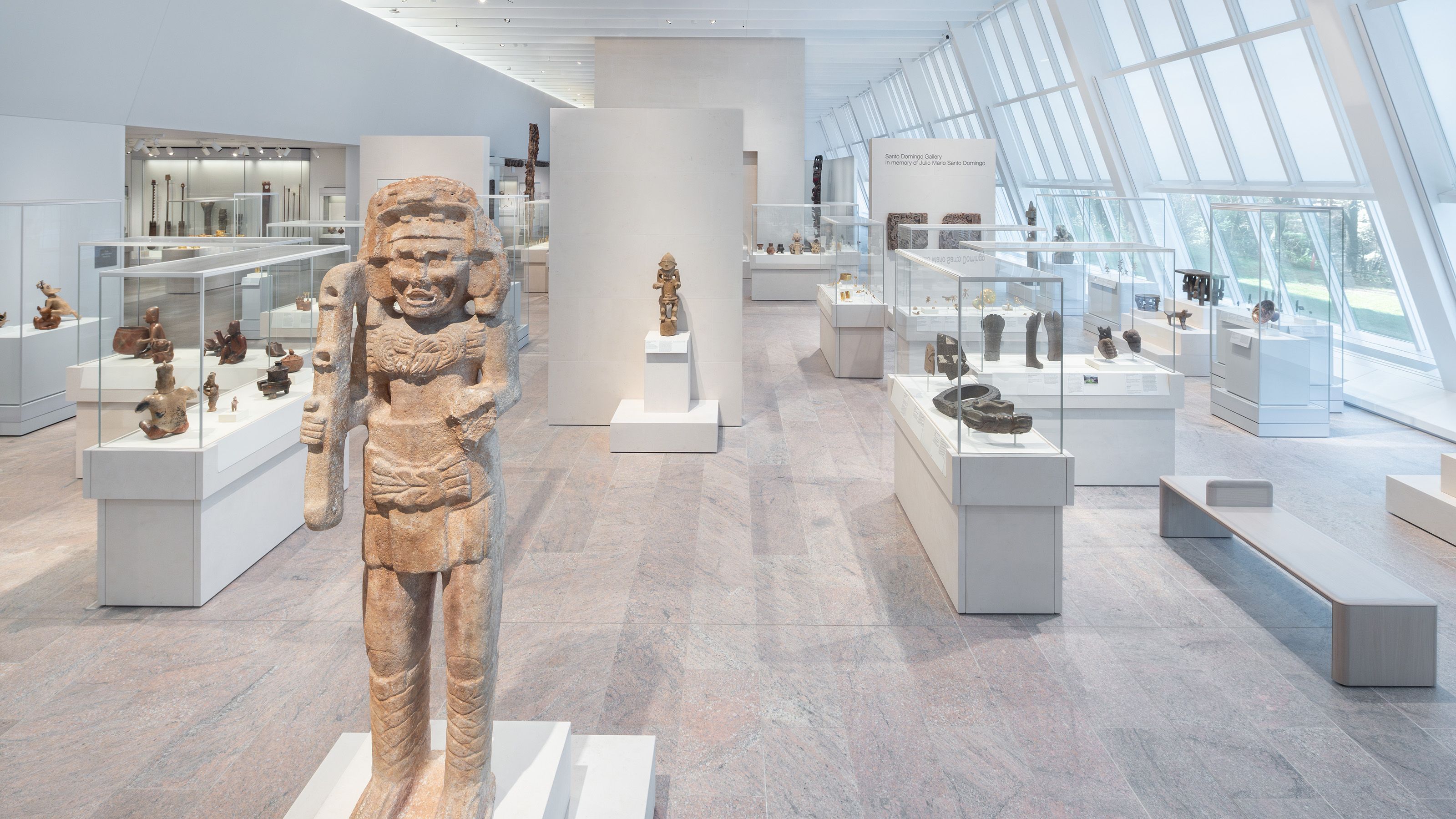
Looking back into prehistory, the collection exhibition Arts of the Ancient Americas at The Metropolitan Museum of Art represents over 6,000 years of visual imagination and cultural meaning. Created in North, Central, and South America before 1600, the objects on display served as markers of identity, expressions of power, or conduits to the divine.
Potters developed distinctive regional styles, such as the reddish-black slip and polished surfaces of northern Guatemala or the stirrup-shaped spouts of Peru’s North Coast. Paired male and female figures in West Mexican tradition embodied duality, sometimes indicating specific ancestors or, perhaps, the primordial couple in whom life originated.
Wall adornments, such as murals and woven textiles, in bold designs and vibrant colors expressed the identities, values, and beliefs of their communities. Gold ornaments were worn in life to indicate authority, while funerary masks and gold plaques carried this status into the afterlife. The influence of colonization can also be traced in these objects, such as Peruvian keros (beakers) on which idealized scenes of Inca history replaced traditional geometric designs.
Art from 1980s–Present
At The Museum of Modern Art
The Museum of Modern Art (MoMA) exhibits a vast collection of modern and contemporary art across several floors of the midtown Manhattan museum. On Floor 2, the collection installation Art from 1980s–Present reveals how contemporary artists have expanded their field by embracing new perspectives and emerging technologies.
Many of the artists on view explore a multiplicity of identities. Agosto Machado has created a shrine to New York City’s downtown countercultures, while Glenn Ligon considers “Black joy as a kind of resistance,” and Dana Claxton celebrates the “the beauty and the bounty” of Indigenous aesthetics.
Others explore innovations in medium or form, such as Richard Serra’s weighty forged-steel cubes or Tala Madani’s use of stop-motion animation. Several artists have added scents to sights: Haegue Yang’s kitchen installation smells of coffee, bread, and apple pie, while Mike Kelley’s installation of plush toys emits Pine-Sol cleaner.
Manhattan offers an exciting variety of arts and culture with many sites within walking distance from each other. While you are in the city, Bloomberg Connects is your guide to discovering new cultural attractions in your vicinity.