The Gordon Parks Foundation’s Michal Raz-Russo on photography and social justice
Written by Kelsey Corbett
March 9, 2026
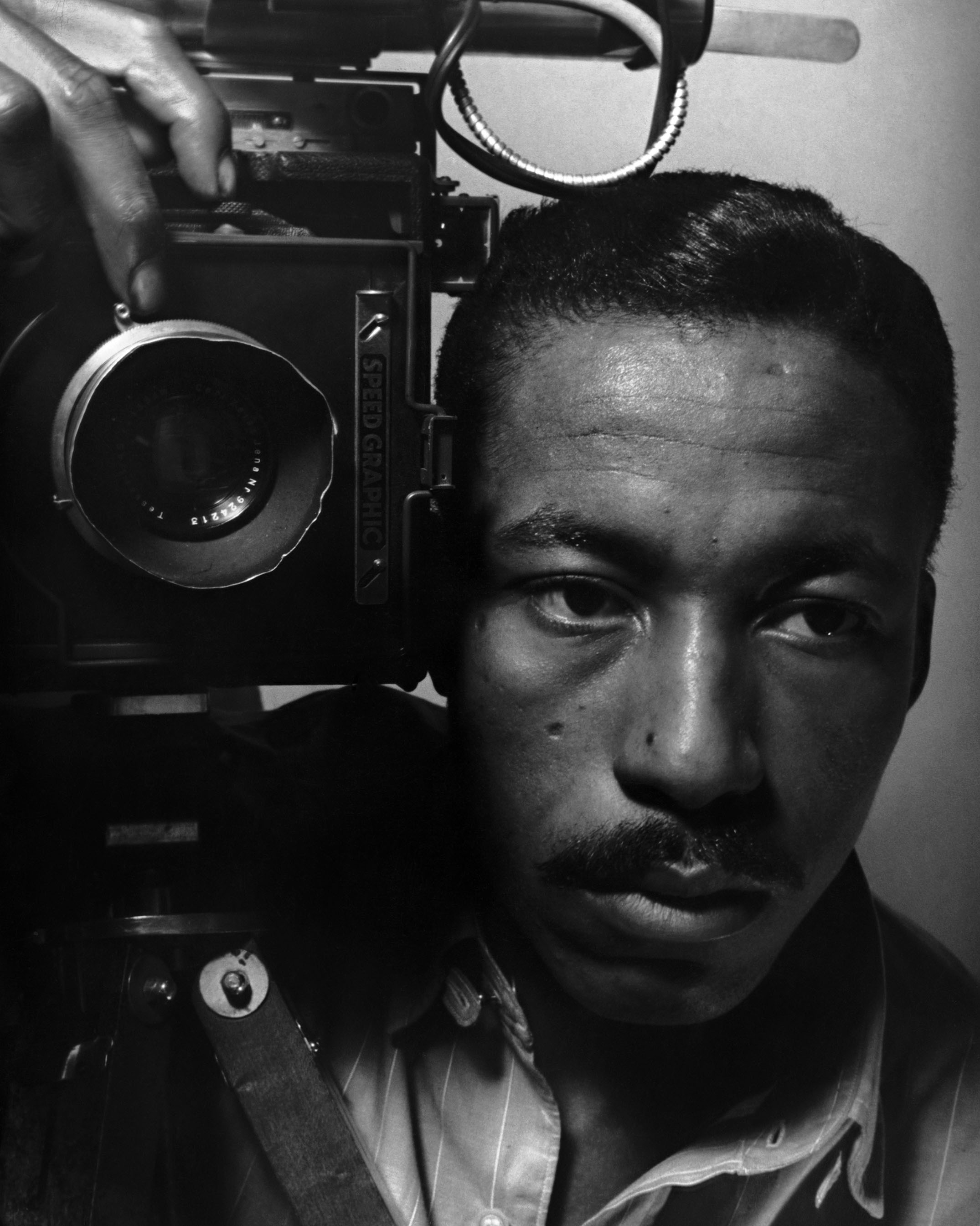
The Gordon Parks Foundation is celebrating its 20th anniversary in 2026. Gordon Parks (1912-2006) was one of the most influential photographers of the twentieth century, who viewed his camera as “a weapon against poverty, against racism, against all sorts of social wrongs.” He was also a distinguished composer, writer, and filmmaker. Co-founded in 2006 by Parks and his longtime editor at Life magazine, Philip B. Kunhardt, Jr., the Foundation preserves the polymath’s creative work and supports a new generation of artists invested in social justice.
Bloomberg Connects spoke to the Foundation’s director of programs, Michal Raz-Russo, about the groundbreaking artist’s ethical approach to photography, self-taught excellence in a variety of creative fields, and enduring commitment to community. In over five years at the Foundation, Michal has overseen their exhibitions, fellowships, prize programs, and publications.
Kelsey Corbett:
For those who aren’t familiar with his life and work, could you explain why Gordon Parks’ photography was so important at the time, and still resonates today?
Michal Raz-Russo:
Whether he was photographing a public figure such as Muhammad Ali or Malcolm X, or someone living far from the spotlight, Parks always spent time with his subjects and got to know them. He captured even the most recognizable figures in moments of striking intimacy, creating images that subtly shifted understanding of them. And through his photographs of everyday individuals, he invited viewers to confront their own relationship to injustice, racism, and power.
This approach began early in his career. Parks was self-taught: as a young man, he encountered photography first on the pages of magazines, bought himself a camera, and taught himself how to see and make work. In 1942 he received a Rosenwald fellowship—becoming the first photographer ever awarded it. The fellowship enabled him to move to Washington, D.C., where he apprenticed with Roy Stryker. Stryker was leading the Farm Security Administration (FSA), a unit tasked with documenting World War II mobilization efforts, as well as the effects of the Depression years on Americans. That apprenticeship became a very important lens through which Parks understood photography.
Among his best-known photographs is one of his earliest, American Gothic, made in Washington, D.C., during his time with the FSA. This was a pivotal work for him. The image depicts Ella Watson, a custodial worker in the government building where Parks was spending time, standing in front of an American flag, mop in hand. Years later he titled the photograph American Gothic, in reference to Grant Wood’s iconic painting at the Art Institute of Chicago.
What is ultimately significant about the work, and helps explain its enduring impact and influence, is that Parks didn’t stop with that one photograph. He took the time to get to know Ms. Watson— photographing her at home, at church, and within her community. That approach became the template for his entire career, especially while working as the first African American staff photographer at Life. He was always attentive to the stories he was telling, to whom they were addressed, and to how he could reframe dominant narratives through his work.
Kelsey:
It seems like he had an incredibly ethical approach to his photography. There’s an ethical conundrum, which I think many photographers struggle with, about turning real people into subjects in a way that isn’t exploitative. But it sounds like Gordon Parks cut through that by being truly embedded with his subjects and their communities. He wasn’t an outsider looking in, but an insider who could convey their stories to the outside world.
Michal:
Absolutely—Parks’ ethical approach is central to understanding his work. As part of the Foundation’s 20th anniversary year, we are publishing an expanded edition of the book on the Fontenelle family, a searing story Parks did for Life in 1967. The series focused on a family living in profound poverty in Harlem, and through their story, Parks sought to convey the effects of systemic racism and structural inequities.
The book on the Fontenelles was, in fact, the first focused book the Foundation published in 2012, the result of our inaugural museum collaboration with the Studio Museum in Harlem. Since then, we have discovered more information and archival material about this body of work. One interview, in particular, illuminates Parks’ method. He explains that, for the first week he spent with the family, he didn’t take out his camera. Instead, he simply spent time with them, to understand who they were and how they wished to be seen.
It is important to remember that Parks was working for Life magazine, which had a predominantly white readership, and he was acutely aware that he was given certain assignments precisely because he was a Black photographer. In his writing, he speaks candidly about being in a very conflicted position, trying to understand his role as well as his responsibilities. What emerges from this particular story, and many others, is that he finds a way to hold up a mirror to society, to Americans, showing audiences that the stories he captured defined America itself.
Kelsey:
It sounds like Gordon Parks was primarily concerned with the stories that he wanted to tell and chose his medium to suit them. That it was less about photography, per se, than about his creative urge and sense of social responsibility, which he expressed through various avenues.
Michal:
Many things about Gordon Parks were extraordinary, not least the range of disciplines in which he excelled. Photography is what he’s best known for, but he was also committed to filmmaking, music, and writing. That came out of a keen understanding of how the arts operate in the world, how they can effect change, and how they can complement each other.
Parks’ interest in writing was, in part, a response to the limits imposed on his photographs once they appeared in print. He understood that his images were often accompanied by text over which he had little control. He also an understanding of how meaning shifts depending on context, and how words and images shape, and perhaps distort, one another. In fact, while he was working at Life, he contributed his own writing to several of his photo essays, which was unusual for any photographer at the time, and allowed him greater authorship.
Parks also made history as the first African American to direct a major Hollywood film, The Learning Tree (1969), adapted from his semi-autobiographical novel published in 1963. That project launched his Hollywood career and, two years later, he directed and scored Shaft, which introduced a groundbreaking vision of a black hero, and helped define a genre that reshaped popular culture.
Parks’ work has become part of our cultural vernacular and our visual history. Our mission at the Gordon Parks Foundation is not only to preserve that legacy, but also extend it. And one of the ways we are doing that is by supporting the next generation of artists and makers who are following in his footsteps.
Kelsey:
Well, that segues almost perfectly into thinking about Parks’ creative legacy. Are there contemporary artists you see as upholding that legacy?
Michal:
There are so many! It is precisely why we launched our fellowship program in 2017, which now exists alongside a book prize, scholarships, and our Legacy Acquisition Fund dedicated to late-career artists. These initiatives honor Parks’ influence by supporting a broad community of artists working at the intersection of art and social justice, who are thinking expansively about how creative practices can enact change.
One of our first fellows, Devin Allen, embodies this spirit. Much like Parks, he is a self-taught photographer, based in Baltimore. Allen began documenting protests in 2015 following the death of Freddie Gray. He shared those images on social media, where they caught the attention of Time magazine. His now-iconic cover photograph—showing a man fleeing police, with “1968” crossed out and replaced by “2015” —is a powerful reminder that history repeats itself, as do images. And similarly to in Parks’ approach, this image sits alongside the many Allen made of his community, that document the joy and resilience that persist.
Kelsey:
It’s an incredible privilege, but also a big responsibility, to safeguard the legacy of an artist—disseminating their work in a way that respects their wishes but also adapts to the times and allows space for new interpretations. As a foundation, how do you adapt the way you share Gordon Parks with the world, as the world continues to evolve?
Michal:
Our approach has always been to look backwards as much as we’re looking forwards. We ground our work in honoring Parks’ intentions, his responses to events of the time, and the conditions under which the work was made. We repeatedly return to archives and primary sources, to present projects in their full complexity. We also invite a range of voices across fields and viewpoints to provide different perspectives. Through this approach, we ensure that Parks’ own voice and intention remain central, inviting viewers to form their own relationship to the work.
The Gordon Parks Foundation, located in Pleasantville, New York, is free and open to the public. For anyone who can’t visit in person, their Bloomberg Connects guide is a rich resource—not just for learning about Gordon Parks, but also the contemporary artists whose work echoes his own.