Geographies of Distance: India at the 61st International Art Exhibition of La Biennale di Venezia
Written by Kelsey Corbett
May 14, 2026
India returns to the 61st International Art Exhibition of La Biennale di Venezia in 2026, following a seven-year hiatus, as one of 100 national participants in the prestigious international art exhibition. Curated by the late Koyo Kouoh (1967–2025), the 61st International Art Exhibition, In Minor Keys, is an invitation to slow down and tune in to the quieter tones and lower frequencies that persist beneath the cacophony and the chaos: “the songs of those producing beauty in spite of tragedy, the tunes of the fugitives recovering from the ruins, the harmonies of those repairing wounds and worlds,” as Kouoh wrote in her introduction.
We spoke to the curator of this year’s group exhibition for the India Pavilion, Dr. Amin Jaffer, about bringing contemporary Indian art to the world stage, balancing modernity with tradition, and using the minor keys to make a major statement.
Kelsey Corbett:
Could you please introduce yourself and your background prior to curating Geographies of Distance: remembering home in the India Pavilion for this year’s Biennale di Venezia?
Amin Jaffer:
I’m a lifelong curator and have been the Director of the Al Thani Collection, a collection of more than 5,000 works of art, with a museum in the heart of Paris, since 2017. I started my career at the Victoria & Albert Museum, working in the research department and eventually the Asian Department, where I generated a number of exhibitions and books about the relationship between India and the West. I then left the museum world for Christie’s, where I was International Director for Asian Art for 10 years. In 2024, I was appointed one of the three Artistic Directors of the Islamic Arts Biennale in Jeddah. And my present role, in addition to my ongoing job at The Al Thani Collection, is to curate the India Pavilion for the Venice Biennale.
Kelsey Corbett:
For India to return to the Biennale after a seven-year hiatus seems rather momentous! Can you tell me about that?
Amin Jaffer:
It’s been a longstanding ambition of mine to curate the India Pavilion in Venice. First of all, India has not been consistently represented in the Venice Biennale. India is the world’s most populous nation and its fourth-largest economy, and yet this is only the third time that the country is hosting a pavilion. India represents not just a modern nation-state, but an ancient civilization with its own distinctive visual culture and vocabulary, which has made a great contribution to world culture, but has not participated in what is the most important platform worldwide for showcasing contemporary visual art. So I already had in mind various ideas of what I wanted to do with this great opportunity to “rebrand” contemporary art from India for a world audience.
When we learned that the theme of the Biennale was In Minor Keys, I began to reflect on what that meant. For me, it really reflects the minor notes on the piano; whereas the major keys are triumphant, positive, jubilant, and powerful, the minor keys are the ones that are tender, elegiac, introspective, soft, maybe a bit melancholic. And I began to think about how we could represent that overall curatorial theme with artworks from India.
The first thing I struck on was the notion of using materials in minor keys – organic, natural, delicate, worked by hand – not materials that shout. I knew automatically that I didn’t want a project that was digital, AI, metallic, technological, or noisy. I imagined the opposite; something that was emotive, sentimental, sensitive, that really made people reflect on aspects of the human condition.
Kelsey Corbett:
What aspects in particular of the human condition are you interested in exploring?
Amin Jaffer:
Well, I’m ethnically Indian and have worked with Indian art all my life, but I wasn’t born or raised in India. What I’ve observed over the past few years is the demographic boom in the country, in which we see over 15 million births every year, the economic boom, in which we see sustained growth at 6–7%, and the technological transformation of the country, which is taking India from quite a closed economy and infrastructure to one that’s engaging with the world on digital platforms. This means that, in terms of physicality, India is being rapidly transformed.
And when I go back, particularly to cities like Ahmedabad, Visakhapatnam, or Bangalore, I don’t really recognize the neighborhoods that I once knew well. They’ve been completely changed. Single-family dwellings are replaced by mid and high rises. The urban infrastructure has changed, with new motorways, airports, and shopping centers. We’re seeing a transformation of India, which is a very positive thing, but it does mean that what was there before has disappeared.
In light of, this I decided that I wanted to focus on this question of what has been lost. I talked to so many friends in India who have subdivided or redeveloped their homes in order to accommodate changes in living conditions and lifestyle – this story is very common because of the pressure on space. It brought up this whole idea of home and belonging and physicality. Where do you feel you belong when the street where you grew up is no longer recognizable to you, or the place you come from has been completely altered? Does the physicality of home matter?
Kelsey Corbett:
What was it about each of the five artists and their practices that resonated with these themes you were considering for the Pavilion?
Amin Jaffer:
The themes that were playing in my mind crystallized when I saw the work of a very talented artist from New Delhi, Sumakshi Singh. She grew up all over India and went to 11 different schools because her father had a peripatetic job; the constant in her life was her grandparents’ house, which they built after the Partition of India in 1947.
When her grandparents died, the family said, “The land values have grown so appreciably, we can’t possibly afford to keep this house. Let’s demolish the house and develop or sell the land.” And of course, this was really traumatic for Sumakshi, because it meant that her childhood was being erased. As an act of mourning and love, she measured the house and recreated it to scale in thread and embroidery.
That’s one of the projects in the Pavilion which when I first saw it, my heart really skipped a beat. I thought this captured something of the human condition of today, not just in India, but everywhere in the world. Our urban environments are constantly being reworked and changed. I wanted to create a narrative around Sumakshi Singh’s thread house, looking at the concept of home, also by addressing the garden and the soil under our feet.
Kelsey Corbett:
What aspects of home, and earth in particular, does Bala’s work bring to the Pavilion?
Amin Jaffer:
Bala (Alwar Balasubramaniam) works in a beautiful studio in a very rural part of Tamil Nadu. He grows crops, loves to cook, and is very sensitive to nature. His story is that human beings take the earth under our feet for granted, but the earth is vulnerable, too. He creates these very spectacular panels of fractured earth. In developing the Pavilion narrative, I felt that visitors must first enter the space and experience the feeling of earth; they then turn to one side and see the thread house.
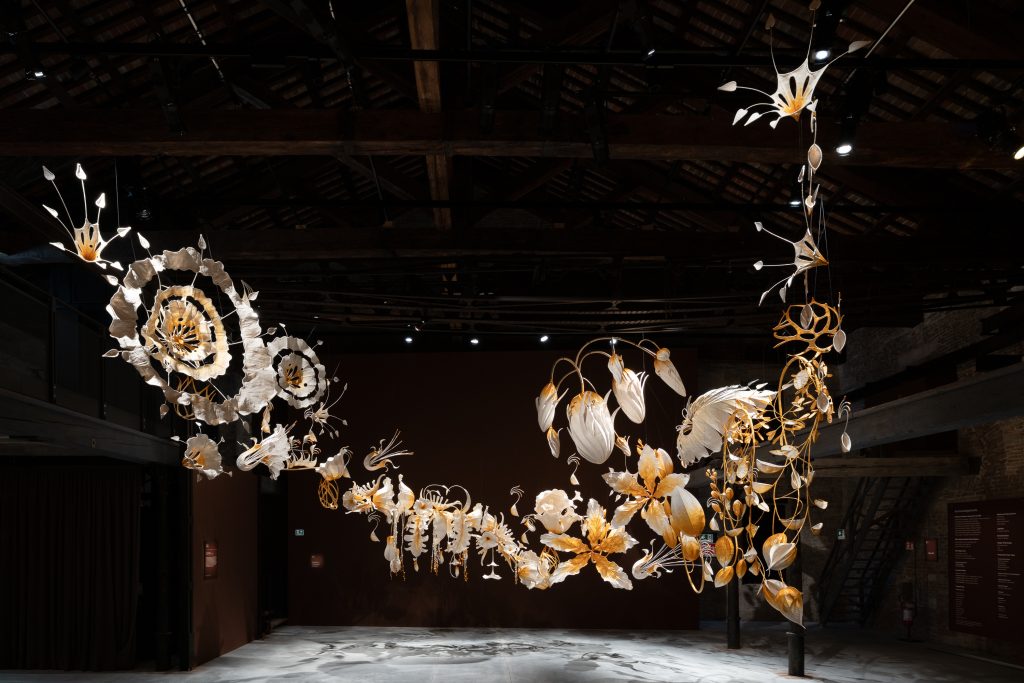
The next element I wanted to bring in was the garden. In India, flowers are not just decorations; we have a very deep civilizational approach to flowers. We have a medicinal and culinary culture based on plants, we adorn ourselves and venerate using flowers, and they are exchanged as signs of love and bonding. Flowers have a very deep symbolism in India and play a strong role in the notion of home. I therefore turned to the artist Ranjani Shettar, who lives in rural Karnataka and is known for her emotionally powerful, mobile sculptures of organic forms. She has created a complex composition of more than fifty independent sculptures suspended in more than seventy points, altogether constituting a floating garden.
Through working with the Ministry of Culture of India, I was exposed to some emerging artists, and for the Pavilion selected Skarma Sonam Tashi, who is from Ladakh. What is happening in the region is that people who lived in very traditionally built houses – made of mud, straw, and wood with thick walls that preserve heat in winter and cool in summer – are now moving into cheaper to produce, easier to maintain, and more comfortable new houses made of steel and concrete with glass windows and new contemporary conveniences.
Once you are living in a mid-rise with a lift and an air conditioning unit, it changes your entire perspective on your place in the local ecosystem. Tashi makes sculptural installations of these traditional houses, in an attempt to capture his childhood memories of home, a home that’s disappearing because fewer people want to live that way.
Kelsey Corbett:
I found it interesting that the title Geographies of Distance: remembering home juxtaposes the ideas of home and distance, which at first seems counterintuitive. But it sounds as if you’re thinking about mobility, memory, and nostalgia – how “home” continues to resonate from afar, despite temporal or geographic distance. How does the work of Asim Waqif fit into this?
Amin Jaffer:
The Pavilion features four projects built around the concept of devotion to the home that was. In order to create dynamic tension with these projects, I invited Asim Waqif, the fifth artist, a trained architect, to respond with a monumental installation. He uses recycled materials and makes very dramatic, engaging, and dynamic sculptures that evoke architecture. Until recently, scaffolding in India and much of East Asia was made of bamboo, so I invited him to create a bamboo scaffolding in the center of the Pavilion, rising above all the other projects. The scaffolding represents the future. We all have feelings about our environment, and the scaffolding symbolizes change – it signifies what is coming next.
So the Pavilion exhibits have four projects which are elegiac reflections on the home, particularly the home as a child that gave you comfort and security, that you feel attached to – and the fifth project, which points towards the future. Today, scaffolding in India is no longer made with bamboo; new building codes mean we’re using industrialized construction materials because they are safer and more secure. So even Asim Waqif’s bamboo sculpture represents a nostalgia for the future that might have been.
I wanted the Pavilion to speak not just to Indians from India, but to the international Indian community across the diaspora. What is fascinating is that, even when they become highly assimilated, they get back into their Indian personality, food, music, language, and attire when it comes to key moments in their lives. There are many things that we Indians all share, whether we are born in Seattle, Kinshasa, or Kuala Lumpur. I myself grew up with the question: how do we maintain this Indianness after one, two, three, four, five, six generations? So, the Geographies of Distance relates also to Indians who are not in India, who ask themselves as they advance through life: where is my home? Where do I come from? Where do I belong?
This is the type of question I want people to ask themselves when they come into the Pavilion. And you will probably conclude that home is not just a physical space; home is a portable condition that depends on rituals, values, the people you love, and the food you eat. There are many aspects that make up a home. That’s what I believe, but I wanted to invite visitors to reflect on their idea of home, while they have all of the elements that make up home around them.
Kelsey Corbett:
It sounds as if materiality plays a significant role in linking person with place and fast-paced change with enduring tradition. How do the specific materials used by the artists in the Pavilion support, or perhaps even complicate, the narrative?
Amin Jaffer:
As our reentry to Venice after seven years, I felt it was important that the Pavilion should be uniquely Indian in its materiality and techniques. Bala’s soil is from Tamil Nadu, Sumakshi’s thread is Indian, and Ranjani’s flowers are made of organic hand-woven cotton painted with a lacquer from tree insects in Karnataka. Tashi’s work is mainly papier-mâché, a technique practiced in India over the centuries, while Asim’s bamboo relates to its historical use in Indian architecture over millennia.
While the techniques and materials are traditional ones, the language, the form of expression, is contemporary. The Pavilion is also accompanied by a project of performances throughout Venice. We’ll have music on boats, poetry and literature readings, dance; we’ll have all kinds of activities that will infuse the city with an Indian mood.
Kelsey Corbett:
There are so many layers of significance and meaning to unpack, which brings us to the question of interpretation. How do you hope to communicate these ideas to visitors, both in their experience of the Pavilion itself and through supplementary materials?
Amin Jaffer:
The Venice Biennale is a rich artistic diet for visitors, who are expected to navigate a key change every 10 or 15 minutes to experience something new. As the makers of a pavilion, we have just a few brief moments to capture the imagination of each person who opens the door and to make them succumb to the power of these projects. So I felt we must develop a project that is comprehensible intellectually and impactful emotionally for everybody who comes through the door, irrespective of whether they’re a collector, a curator, or a layperson.
On the one hand, the more you know about the artists and the project, the better; but we must also appeal to people who do not read the text while they’re there. What I like about Bloomberg Connects is that it provides various levels of information. It allows people to just walk through and understand the layout of the space, or invites them to really sit with the content. It takes the pressure off when visitors can use the QR code to capture the information and refer to the guide materials later. One of the great things about the technology is that visitors can leave with the images, the information, the voices of the artists, and the words of the curator to enrich their experience of the Pavilion post-visit.
La Biennale di Venezia runs from Saturday 9 May to Sunday 22 November 2026 (with preview days on 6–8 May) at the Giardini and the Arsenale venues, and in various locations around Venice. The India Pavilion, Geographies of Distance: remembering home, is located in La Biennale di Venezia’s Arsenale venue. It was organized by the Government of India’s Ministry of Culture in partnership with the Nita Mukesh Ambani Cultural Centre (NMACC) and Serendipity Arts, curated by Amin Jaffer, with works by Alwar Balasubramaniam (Bala), Sumakshi Singh, Ranjani Shettar, Asim Waqif, and Skarma Sonam Tashi.