Tropical Hyperstition: Panama at the 61st International Art Exhibition of La Biennale di Venezia
Written by Kelsey Corbett
May 15, 2026
For the second time in its history, Panama has a pavilion at the 61st International Art Exhibition of La Biennale di Venezia, following the nation’s inaugural participation in 2024. The 61st International Art Exhibition, In Minor Keys, was curated by the late Koyo Kouoh (1967–2025), who conceived of it as “an exhibition that invites listening to the persistent signals of earth and life, connecting to soul frequencies … a polyphonous assembly of art, convening and communing in convivial collectivity, beaming across the void of alienation and the crackle of conflict.”
We spoke to the co-curators of the Panama Pavilion, Ana Elizabeth González and Mónica Kupfer, about rewriting historical narratives, the significance of indigo textiles, and looking to the past in building a brighter future.
Kelsey Corbett:
Not only is this the second iteration of the Panama Pavilion, it’s also your second time as its co-curators. Could you please introduce yourselves, your backgrounds, and how this curatorial duo came into being?
Ana Elizabeth González:
I am Executive Director and Chief Curator of Museo del Canal, the Panama Canal Museum. My work is focused on the intersection of history, contemporary art, and community-centered practice – particularly on how cultural institutions can communicate the complex and often unresolved histories that shape a country. At the Panama Canal Museum, my work has involved expanding narratives through which Panama is understood, especially around questions of infrastructure, decolonization, migration, race, and sovereignty.
So in that sense, co-curating the Panama Pavilion with Mónica felt like a natural extension of the work I’ve been developing institutionally, but on a much more visible and international platform. And, because we co-curated Panama’s first national participation at the Biennale in 2024, this second iteration feels like part of a broader and growing curatorial commitment.
Mónica Kupfer:
I have a doctorate in art history with a focus on Latin American art – in particular, Central American and Panamanian art. I was the first curator at the Panama Contemporary Art Museum and have worked freelance since the 1980s, organizing exhibitions and writing about art in Panama and Central America. One of the things that makes me feel like I’ve come full circle is that I co-founded the Panama Art Biennale, which was held on eight occasions between 1992 and 2008. The process of curating a national biennale helped when it came to curating the Panama Pavilion at an international biennale.
Kelsey Corbett:
The first time must have been both an honor and a responsibility to represent contemporary art in Panama on an international stage! How does the experience of being back again compare, and has your curatorial approach changed between the two iterations?
Ana Elizabeth González:
It’s both a responsibility and an opportunity for growth. There is naturally an awareness that the Pavilion contributes to how the country’s contemporary art is read internationally, but that pressure has also been productive. It encourages rigor, clarity, and a process that is historically grounded but intellectually developed. I see this year’s participation as part of that important continuity, because it suggests that Panama is articulating a more sustained relationship to this platform and to other international platforms through contemporary art.
Mónica Kupfer:
Our second exhibition builds on the first. In addition to showing the world that we have contemporary artists worth considering, we’re showing that we have something to say through works that are sociopolitically engaged. Last time, the focus was on migration, how the Panama Canal was built by people who migrated from the Caribbean – as well as from other countries, including Spain and Italy – but also about migration as a crisis of our time. This year, the topic is the Canal Zone. This was an area populated by those who had worked on the canal, before they were uprooted and their towns destroyed. The Panama Canal was built on land that belongs to Panama, but was occupied by a foreign power, a form of modern colonialism.
Ana Elizabeth González:
The Canal Zone effectively functioned as a country within another country, which Panamanians could not enter without permission. And that was all through the logistical and economical power of a waterway. So our curatorial premise frames that history of a colonial enclave that reorganized daily life through restriction and control. What makes this especially compelling is that its legacy continues to reverberate in our country today. The Canal Zone is still a recent memory for many Panamanians and renewed geopolitical attention around the canal has made the questions of sovereignty visible again. So this is a very necessary contemporary conversation, as much as a historical one.
Mónica Kupfer:
Who owns the land that one lives on? Who decides if you’re allowed to stay on that land and whether or not it’s yours because you’ve been there for centuries? That issue of who belongs where is very current, and we’ve found a historical example of how this was important to Panama’s establishment as a republic and the building of the Panama Canal.
Kelsey Corbett:
There’s obviously a fascinating and multi-layered history here – can you explain how these themes come through in the Pavilion installation itself?
Ana Elizabeth González:
We selected the artists through an open call, inviting them to respond to a curatorial concept, followed by an evaluation by an independent international jury. The chosen proposal by Antonio José Guzmán and Iva Jankovic, working together as Messengers of the Sun, stood out because they transformed our concept into an aesthetic language that felt conceptually rigorous and materially compelling. It begins from an understanding that the Panama Canal was never only an engineering feat; it was also a territorial and political project that profoundly reshaped land, labor, movement, and everyday life.
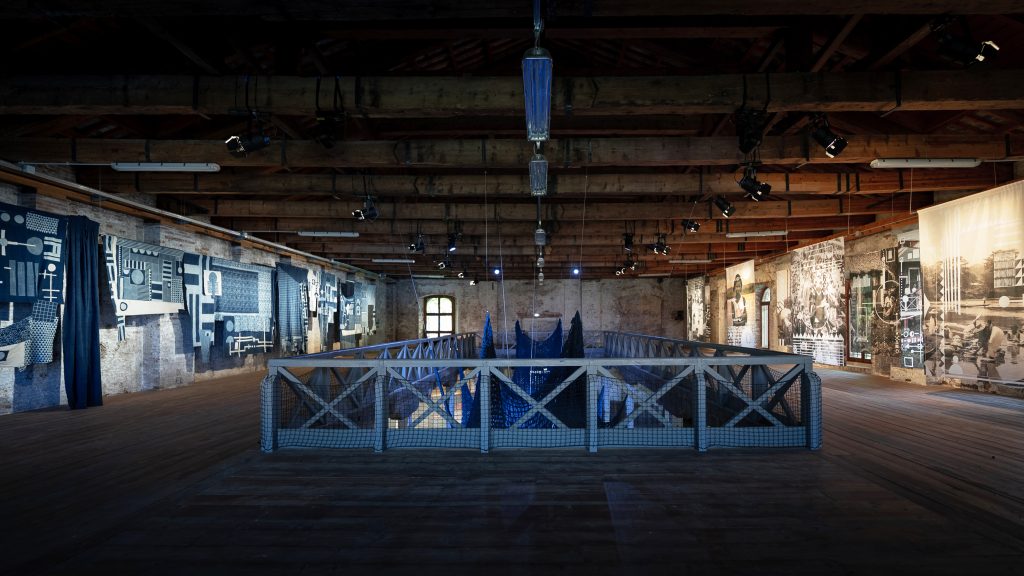
As soon as you enter the Pavilion, the first thing you see is a monumental hammock, 20 meters long and handwoven in indigo-dyed fabric. It’s central because it gathers several overlapping genealogies into a single form; it reaches back to practices of Indigenous people of the Americas, including Panama, while also recalling the material culture of Afro-Caribbean workers who came to Panama during the construction of the canal. In the installation, it becomes a structure of refuge, support, and home while also evoking those who were uprooted from these lost towns.
Mónica Kupfer:
Interestingly, this huge hammock also looks like a boat or a fishing net, and we’re in the Arsenale, a former shipyard – this all symbolically connects to the experiences of people who migrate for work, like the canal workers. In addition to this hammock, which is our centerpiece, there are two other sections. One has a wall of indigo-dyed fabric printed with Guzmán’s DNA pattern and other symbols, like African Adinkra symbols or Mesoamerican shapes, that have different meanings. You don’t understand them all, but you’re pretty clear that there’s something happening here that has to do with history and, overwhelmingly, with the blue cloth.
Ana Elizabeth González:
There’s also an area with historical photography and postcards of the people that lived in these so-called lost towns that have been enlarged and printed on textiles. These spectral textiles envelop the hammock and the installation, watching over everything in the Pavilion. And there’s a soundscape which combines the sounds of nature, water, and machinery with Afro-Caribbean rhythms, traditional music from our region, and the voices of people. Specifically, we have the voice of a hammock maker, explaining in the language of the Guna people how she makes hammocks and why it’s important for our culture not to lose this tradition. This will all be activated with a performance by Messengers of the Sun on opening day, which is going to be really amazing.
Kelsey Corbett:
I feel like we’ve had a virtual, verbal tour of the Pavilion! Could we talk about the colonial and symbolic significance of indigo? There’s an unexpected synergy with one of the artists showing in the Uganda Pavilion, Stacy Gillian Abe, whose painted indigo figures confront the historical trade of enslaved East African people for indigo-dyed cloth. Could you explain how the materiality and history of indigo plays out in the Panama Pavilion?
Mónica Kupfer:
Messengers of the Sun have been using indigo in their work for over 10 years, linked to these legacies of enslavement, exchange, and displacement. In Europe, blue cloth had this huge appeal as a distinguished, even royal, color that was considered rare and special. Messengers of the Sun tell us the story of indigo from the point of view of those who suffered to grow and gather the indigo, then dye the cloth that was prized by people who probably had no idea how much suffering had gone into their clothes.
Antonio José Guzmán is from Panama, Iva Jankovic was born in Yugoslavia, and they’re both immigrants who’ve spent much of their lives in Holland. Their time in Holland, I think, led to the idea of working with indigo as a symbol for the Black Atlantic, considering how the Dutch colonies were particularly intent on growing and dealing in indigo. So there’s a connection to where they live and to where he’s from.
Messengers of the Sun told us they feel a need to go back to what’s natural, such as by reintroducing natural indigo dye, which has mostly disappeared because fake blue dyes have replaced it. They think it would help the world ecologically, for example, if we began using indigo again, without all the suffering involved in the colonial period, but viewed instead as a product from nature that could generate jobs if it replaced the chemical dyes that are processed industrially. Part of their “hyperstition” concept concerns creating a future that’s better than the past by reinterpreting these histories.
Kelsey Corbett:
Could you explain the exhibition title Tropical Hyperstition and how you conceive of its themes in relation to the 61st International Art Exhibition, In Minor Keys?
Ana Elizabeth González:
“Hyperstition” is a fiction that, when reiterated multiple times, transforms our reality in the future. In the case of the Pavilion, by retelling the history of the lost towns in our context and our narrative, rather than the American version, we can transform the memory, identity, and reality of our country and its histories.
Mónica Kupfer:
It’s a philosophical concept that allows us to rewrite our history and understand it in a new way, especially from a different perspective with facts that weren’t previously known because whoever was dominant wrote the history. So it’s a very positive concept. And then “tropical” relates to the North American perception of Panama as a huge jungle that they were powerful enough to control and dominate to produce this masterpiece of engineering: the Panama Canal.
Ana Elizabeth González:
I think that’s where I see a meaningful conversation with the Biennale theme, in the material presence of interrupted memory. We’re not speaking of the official history, but rather what this official history suppresses: the residues, the absences, the domestic traces, the sonic memories, the forms of belonging, the means of survival. These have a quieter weight – not because they’re insignificant, but rather because they don’t exist in the dominant historical narrative. And it encourages visitors to pay attention to that which lingers in those materials and rhythms, as a kind of emotional afterlife.
Mónica Kupfer:
It’s also the underlying minor stories within a framework of a major event in world history, the opening of the Panama Canal. We’re looking at all these quieter stories that haven’t been told properly.
Kelsey Corbett:
We’ve been talking about a very fraught history and its ongoing reverberations in the present, so it’s beautiful that Tropical Hyperstition balances that with a restoration of lost narratives and hope for a better future. With so many conceptual layers and symbolic nuances to unpack, how do you foresee visitors engaging with the installation? And what role does interpretation play?
Mónica Kupfer:
We’re not giving people the story on a plate, they’re going to have to wonder and do a little reading to capture its full significance. But even if they don’t, just the space and the light and the overwhelming blue of the hammock is emotionally impressive. There’s something about it that stirs the viewer.
Ana Elizabeth González:
This work has many layers – the historical, the political, the sound, the material – and not every visitor will arrive at the Pavilion with the same familiarity with Panama’s history, the context of the Canal Zone, or the history of indigo. The Bloomberg Connects guide offers an extension of the Pavilion experience and another point of entry without reducing the work to a single interpretation. It’s especially valuable in that it can hold both orientation and depth, adding to visitors’ understanding of key elements while allowing the installation itself to remain sensorial and open. And then the work can stay with people beyond their visit to the Pavilion, allowing the conversation to continue after they leave the space.
La Biennale di Venezia runs from Saturday 9 May to Sunday 22 November 2026 (with preview days on 6–8 May) at the Giardini and the Arsenale venues, and in various locations around Venice. The Panama Pavilion, Tropical Hyperstition, is located in La Biennale di Venezia’s Arsenale venue, at Tesa 42 Arsenale, Fondamenta Case Nuove, 2738/c. It was commissioned by Gianni Bianchini and co-curated by Ana Elizabeth González and Mónica Kupfer, with works by the artist duo Antonio José Guzmán and Iva Jankovic, known as Messengers of the Sun.