Experience the genius of Robert Rauschenberg
January 21, 2026
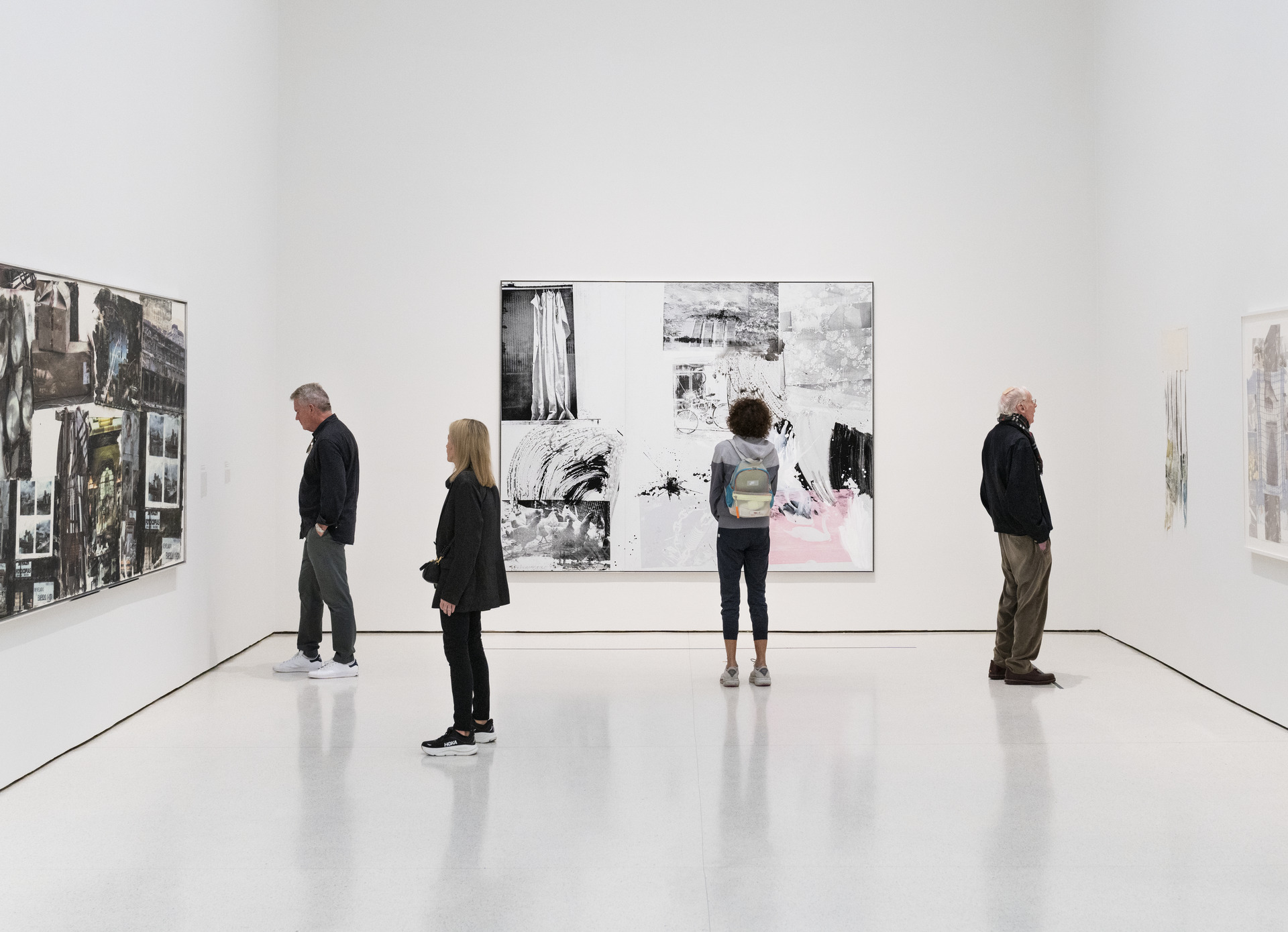
To mark the centennial of American artist Robert Rauschenberg (1925–2008), the Guggenheim New York is hosting Robert Rauschenberg: Life Can’t Be Stopped, which includes a dozen seminal works from their permanent collection alongside major loans from the Robert Rauschenberg Foundation. As an artistic polymath, Rauschenberg explored an astonishing variety of mediums and modes of making across his career, expanding the boundaries of what we consider “art.”
As Joan Young, Senior Director of Curatorial Affairs at the Guggenheim, says: “When he felt too comfortable with one process, Rauschenberg would try a new approach, evidence of his endless curiosity and willingness to take risks.” He repeatedly brought the real world into his work, whether collaging newsprint and fabric into his Red Paintings, incorporating household furniture and taxidermy into his Combines, or experimenting with kinetic sculptures in his Revolver series.
Whether you already know and love his work, or this is your first introduction to Bob Rauschenberg, read on for ten facts about the man, the myth, and material experimentation.
- So who was he? Born Milton Ernest Rauschenberg on October 22, 1925, in Port Arthur, Texas, Rauschenberg changed his name to the more down-to-earth Bob (subsequently Robert). After serving in the military, he enrolled at Black Mountain College in North Carolina, where he was taught by Bauhaus pioneer Josef Albers.
- Considered a forerunner of practically every postwar American art movement since Abstract Expressionism – including Pop art, Minimalism, and Conceptualism – he wasn’t interested in saddling himself with an -ism. Instead, Rauschenberg’s guiding ethos was that his work “relates to both art and life,” claiming “I try to act in the gap between the two.”
- What’s unique about his work? Through Rauschenberg’s expansive approach to “art” materials, he brought the real world into his canvases – often going curbside foraging for urban detritus across New York City. Some of his most unorthodox inclusions were umbrellas, rotary fans, chairs, ladders, a bald eagle, and even a stuffed goat! Later on, he also created an entire series of sculptures from battered cardboard boxes.
- The artist’s approach to printmaking was equally eccentric. He once created a print by getting composer John Cage to drive his Model-T Ford across 20 sheets of paper, leaving a 286-inch tire track. He also developed an innovative solvent transfer technique for combining magazine and newsprint images into new compositions.
- Some works are defined by absence rather than presence. In one of his most infamous acts, he erased a drawing by Willem de Kooning and displayed the resulting work as his own. Inspired by Cage’s minimalist composition 4’33” (which involved a musician not playing their instrument for the specified time), Rauschenberg also created all-white paintings which reflected the ambient light and shadow of their surroundings.
- How did Rauschenberg collaborate with others? From early blueprints created in their tiny bathroom with then-wife Susan Weil to artistic and romantic partnerships with Cy Twombly and Jasper Johns, from dance collaborations with choreographers Merce Cunningham and Trisha Brown, to cutting-edge creations with engineers through Experiments in Art and Technology (E.A.T.), Rauschenberg welcomed other creatives into his orbit.
- Often working with engineers, Rauschenberg created groundbreaking kinetic and sonic sculptures in the 1960s, such as the kaleidoscopic rotating disks of the Revolver works, the bubbling vat of bentonite powered by microphones in Mud Muse, and the babbling of concealed AM radios in the junk metal assemblage Oracle.
- How did Rauschenberg support other creatives? He was an artists’ artist, founding the non-profit Change, Inc. to help artists with emergency expenses, and an early advocate for the importance of creative exchange. He personally funded the Rauschenberg Overseas Cultural Interchange (ROCI), traveling to ten countries – including Mexico, China, Tibet, Germany, and the USSR – from 1984 to 1991 to spark cross-cultural dialogue through art.
- The name of the ROCI program pays homage to the artist’s pet turtle, Rocky. His 1965 performance, Spring Training, involved 30 turtles moving across the darkened stage with flashlights taped to their shells. While the others returned to the pet store afterwards, Rocky remained with Rauschenberg until both their deaths in 2008.
- Want to follow in Rauschenberg’s footsteps? The artist’s home studio on Captiva Island in Florida (where he moved in 1970) was the site of the Rauschenberg Residency. In keeping with Rauschenberg’s collaborative and supportive spirit, the residency welcomes international artists of all disciplines to live, work, and create together in an interdisciplinary environment.
Robert Rauschenberg: Life Can’t Be Stopped is on view at the Guggenheim until May 3, 2026. Other institutions around the world are also commemorating Rauschenberg’s life and legacy with retrospective exhibitions. You can see his work at a variety of Bloomberg Connects partners across the US, including NSU Art Museum, Fort Lauderdale; Museum of the City of New York; Walker Art Center, Minneapolis; Nasher Sculpture Center, Dallas (from January 31, 2026); and The Glass House, New Canaan (from April 16, 2026). To learn more about the artist and his centennial celebrations, please visit the Robert Rauschenberg Foundation guide.